

Hey there! I'm a supplier of Hand Lever Hoists, and I've been in this business for quite a while. One question I often get from customers is how to adjust the braking force of a hand lever hoist. Well, in this blog, I'm gonna share some tips and tricks on this topic.
First off, let's understand why adjusting the braking force is important. A hand lever hoist is a handy tool used for lifting and pulling heavy loads. The braking system is crucial as it ensures the safety of the operation. If the braking force is too weak, the load might slip during the lifting or holding process, which can be extremely dangerous. On the other hand, if the braking force is too strong, it can make the operation difficult and may even damage the hoist.
So, how do we adjust the braking force?
Step 1: Know Your Hand Lever Hoist
Before you start adjusting the braking force, you need to have a good understanding of your hand lever hoist. Different models may have different braking mechanisms and adjustment methods. So, the first thing you should do is to read the user manual carefully. The manual will provide you with detailed information about the hoist's braking system and how to adjust it. If you don't have the manual, you can usually find it on the manufacturer's website.
Step 2: Preparation
Once you've familiarized yourself with the hoist, it's time to prepare for the adjustment. First, make sure the hoist is in a safe and stable position. You don't want it to tip over or move during the adjustment process. Also, ensure that the load is properly secured and that there are no people or objects in the vicinity that could be affected by the adjustment.
You'll also need some basic tools for the adjustment. Usually, a wrench or a screwdriver is enough, depending on the type of adjustment mechanism your hoist has. Make sure the tools are in good condition and are the right size for the job.
Step 3: Locate the Braking Adjustment Point
The next step is to locate the braking adjustment point on the hand lever hoist. This can vary depending on the model. In some hoists, the adjustment point is a screw or a nut that can be tightened or loosened to increase or decrease the braking force. In others, it may be a lever or a knob that needs to be turned.
If you're having trouble finding the adjustment point, refer to the user manual again. It will usually have a diagram or a description that shows you exactly where the adjustment point is located.
Step 4: Make the Adjustment
Now that you've located the adjustment point, it's time to make the adjustment. If the braking force is too weak and you need to increase it, you'll typically need to tighten the adjustment screw or nut. Use your wrench or screwdriver to turn it clockwise. Make small adjustments at a time and test the braking force after each adjustment.
To test the braking force, you can try to lift a small load with the hoist. If the load holds securely without slipping, then the braking force is appropriate. If the load slips, you need to increase the braking force further.

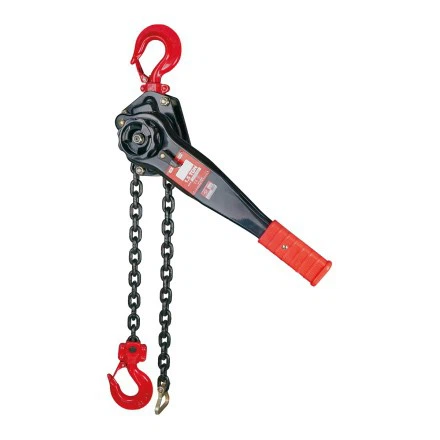
On the other hand, if the braking force is too strong and you need to decrease it, you'll need to loosen the adjustment screw or nut. Turn it counter - clockwise using your tool. Again, make small adjustments and test the braking force after each one.
Step 5: Final Checks
After you've made the adjustment, it's important to do some final checks. First, make sure that all the screws and nuts are tightened properly and that there are no loose parts. Then, test the hoist with a full - rated load if possible. This will give you a better idea of whether the braking force is adjusted correctly.
Also, check for any unusual noises or vibrations during the operation. If you notice anything abnormal, stop using the hoist immediately and re - check the adjustment or consult a professional.
Comparison with Other Manual Lifting Tools
While we're on the topic of hand lever hoists, it's worth comparing them with other manual lifting tools like Hand Chain Hoist and Hand Winch.
A Hand Chain Hoist uses a chain to lift the load. It's often used for vertical lifting and is known for its simplicity and reliability. However, compared to a hand lever hoist, it may not have as precise a braking system. Adjusting the braking force in a hand chain hoist can be more complex and may require more specialized knowledge.
A Hand Winch, on the other hand, is mainly used for pulling loads horizontally. It has a different design and braking mechanism compared to a hand lever hoist. The braking adjustment in a hand winch is also different and usually involves adjusting the tension of a cable or a drum.
In conclusion, adjusting the braking force of a hand lever hoist is not a difficult task if you follow the right steps. By reading the user manual, preparing properly, locating the adjustment point, making small adjustments, and doing final checks, you can ensure that your hoist's braking system is working correctly.
If you're in the market for a high - quality hand lever hoist, or if you have any questions about our products, feel free to contact us. We're always here to help you with your lifting needs. You can check out our Hand Lever Hoist on our website for more details.
References
- Manufacturer's user manuals for hand lever hoists
- Industry standards and guidelines for manual lifting tools


