

Hey there! As a supplier of Articulated Boom Lifts, I often get asked whether these nifty machines can be used on uneven ground. It's a valid question, especially considering the diverse job sites where these lifts are put to work. So, let's dive right in and explore this topic in detail.
First off, what exactly is an Articulated Boom Lift? Well, you can check out more about it here. These are aerial work platforms that feature multiple sections or "booms" that can be articulated or bent at joints. This allows for greater flexibility and reach, making them ideal for tasks like tree trimming, building maintenance, and construction work in hard-to-reach areas.
Now, let's talk about uneven ground. Job sites can be pretty unpredictable, and not all of them have perfectly flat surfaces. There could be slopes, bumps, or even holes. So, the question is, can an Articulated Boom Lift handle such conditions?
The short answer is, it depends. Some Articulated Boom Lifts are designed to handle a certain degree of unevenness. They come with features like self-leveling outriggers. These outriggers can adjust themselves to ensure the lift remains stable on slightly uneven ground. When the lift is set up, the outriggers extend and make contact with the ground. They can then adjust their height independently to compensate for any differences in the surface level. This helps to distribute the weight of the lift evenly and prevent it from tipping over.
However, there are limits to what these features can do. If the ground is extremely uneven, with large slopes or deep holes, it's a different story. In such cases, using an Articulated Boom Lift can be extremely dangerous. The lift may not be able to maintain its stability, and there's a high risk of it tipping over. This not only endangers the operator but also those working in the vicinity.
Before using an Articulated Boom Lift on uneven ground, it's crucial to conduct a thorough site assessment. Check the ground conditions carefully. Look for any signs of instability, such as soft soil or loose gravel. Measure the slope of the ground. Most manufacturers specify the maximum slope angle that their lifts can safely operate on. If the slope exceeds this limit, it's best not to use the lift.

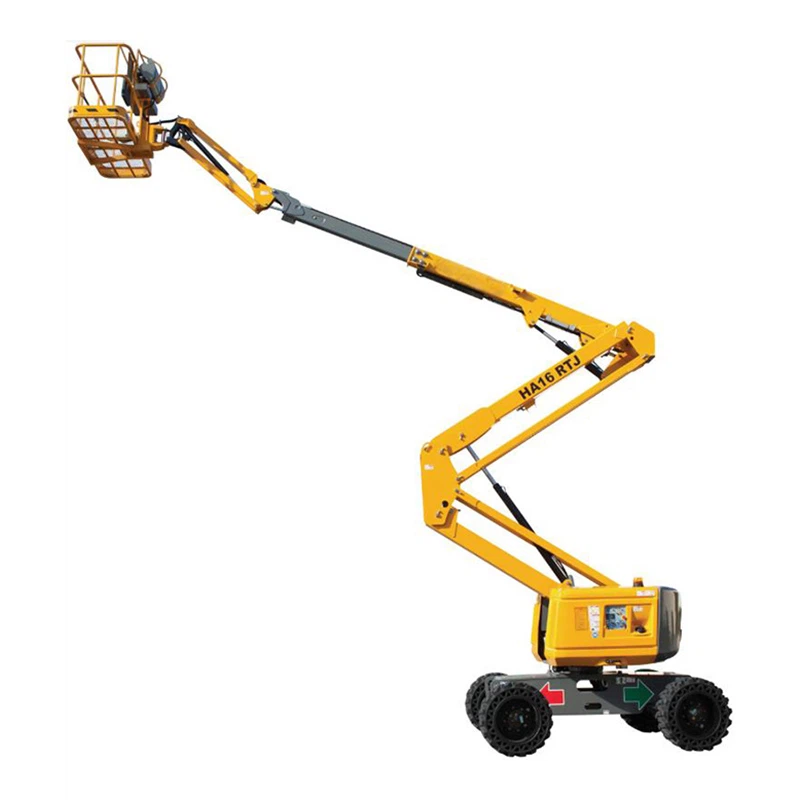
Another important factor to consider is the load capacity. When the lift is on uneven ground, the weight distribution can change. This means that the lift may not be able to carry the same load as it would on a flat surface. Always refer to the manufacturer's guidelines regarding load capacity on uneven ground. Overloading the lift can further compromise its stability and lead to accidents.
It's also a good idea to train your operators properly. They should be aware of the limitations of the lift on uneven ground. They need to know how to set up the lift correctly, including extending the outriggers and ensuring they are properly positioned. Operators should also be trained to recognize the signs of instability and know what to do in case of an emergency.
Now, let's compare Articulated Boom Lifts with other types of lifting equipment in terms of their suitability for uneven ground. For example, Freight Elevators are typically installed in buildings and are designed to operate on flat, stable surfaces. They are not suitable for outdoor job sites with uneven ground.
On the other hand, Manual Hydraulic Platform Trucks can be used on relatively flat surfaces. They are more mobile than Freight Elevators but still have limitations when it comes to uneven ground. They don't have the same level of stability and reach as Articulated Boom Lifts.
In conclusion, an Articulated Boom Lift can be used on slightly uneven ground if it has the appropriate features and the ground conditions are within the specified limits. However, extreme unevenness is a no-go. Safety should always be the top priority when using any type of lifting equipment.
If you're in the market for an Articulated Boom Lift and have questions about its performance on uneven ground, or if you're just looking for more information about our products, don't hesitate to reach out. We're here to help you make the right choice for your specific job requirements. Whether it's a small-scale project or a large construction site, we have the expertise and the equipment to meet your needs. So, let's start a conversation and see how we can assist you in getting the most out of your lifting operations.
References
- Manufacturer's manuals for Articulated Boom Lifts
- Industry safety standards for aerial work platforms
- Research on the stability of lifting equipment on uneven surfaces


